

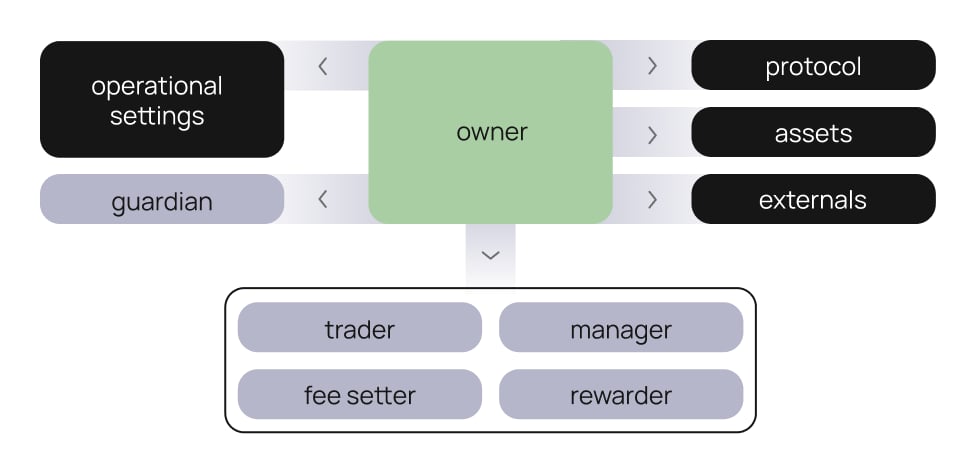
Roles
Owner
The Owner is the highest authority within the protocol and is responsible for assigning and managing all other roles. The Owner has the ability to modify critical protocol settings, subject to timelock constraints as well as day-to-day protocol configuration without timelock.The Owner role is secured by a 3-of-6 multi-signature wallet.
Guardian
A Guardian role provides emergency risk controls, enabling protective actions such as pausing protocol functionality.Operator
Operators are specialized operational roles who execute predefined functions within strict boundaries.- Trader: Executes strategy-related transactions (e.g., borrow, stake, swap)
- Manager: Manages funding of withdrawal claims
- Rewarder: Performs reward logging accounting updates
- Fee Setter: Can set custom exit fee
All role changes are timelocked.
Active Roles
Active Roles
Owner: SM1QXYXZG78DCWJZJKY0901KTK3350071W9YYRPMT (3/6 multi-sig)Guardian: SM1QXYXZG78DCWJZJKY0901KTK3350071W9YYRPMT (3/6 multi-sig)Trader: SP20V8SG811G6CT2QMZQNX6XCN20YAX36DYD1BAE0Rewarder: SP20V8SG811G6CT2QMZQNX6XCN20YAX36DYD1BAE0Manager: SP20V8SG811G6CT2QMZQNX6XCN20YAX36DYD1BAE0Fee Setter: None
Settings
Protocol
Defines the set of core protocol smart contracts with the ability to invoke internal contracts, move assets within the system, and execute approved external contract calls.Assets
Specifies the assets that protocol smart contracts are authorized to custody, transfer, and deploy as part of strategy execution.Externals
Defines the external smart contracts that the system is permitted to interact with, including money markets, yield protocols, and swap interfaces.All security-sensitive setting updates are timelocked.
Active Settings
Active Settings